Category: Non classifié(e)

  • How a Prorogued Parliament Could Help Harm Reduction

    How a Prorogued Parliament Could Help Harm Reduction

    Today the Conservative government prorogued the Canadian parliament. What this means is that the current legislative agenda, on hold when parliament recessed for the summer, is now dead. This move does not come as much of a surprise given the recent cabinet shuffle that signaled some shifts in direction for the current government, and prorogation will give them a chance to reboot its legislative and parliamentary agenda.

    This is potentially good news for those of us who have been watching the progression of Bill C-65 (Respect for Communities act). The extensive provisions of Bill C-65 promised to make it more difficult to implement new supervised injection services in Canada because of the myriad levels of approval that service providers would need to demonstrate in their applications (potential service providers must make an application to the federal Minister of Health for an exemption to the Controlled Drugs and Substances Act if they wish to shield clients and staff from potential drug charges). Now that Bill C-65 is dead it gives us some breathing room to continue to work on getting more supervised injection services in Canada.

    But dead does not necessarily mean buried. The CDPC will be watching closely when the Harper government announces its new legislative agenda in the fall. There’s always the chance the Harper government could reintroduce the bill in either its current form or as a revised attempt to muzzle harm reduction in Canada. Stay tuned. You know we will be.

    In the meantime, September 30, 2013 (9/30) is the second anniversary of the Supreme Court of Canada’s decision that allowed Insite (Vancouver’s supervised injection site) to stay open. The CDPC is working with our partners across the country to encourage local groups to host events and activities that mark this important occasion and raise the profile of safer consumption services in Canada. We hope you will join or help organize one of these events in your community.

    For organizations: Consider creating a mock injection site open to the public and the media and ask local supportive nurses to be on hand to answer questions. You might also want to do something simple like creating a media release making the case for these services in your city.

    For individuals: Send a letter to the local paper expressing your dismay at the lack of support for safer consumption services in your region or write an editorial for you local paper and along the lines of the letter suggested above. Visit your local MP, mayor, or other politicians and make the case for these services in your community. Let them know that the safety and health of every member of your community is important and that’s why you support these services. And don’t forget to the write letters to the Prime Minister’s Office expressing your concerns about the lack of federal support for harm reduction services.

    We are creating a tool kit of ideas for this day so contact Connie Carter if you would like more information.

  • The Harm Reduction debate: Political Expedience vs Progress

    The Harm Reduction debate: Political Expedience vs Progress

    On June 24th, the Urban Health Research Institute released a report on 15 years of data on drug use in the city of Vancouver. The results of their analysis are significant, but predictable to those who work in the field – harm reduction has saved lives and led to a decrease in drug use, while the war on drugs had failed to do either.

    Since the mid 1990’s, the number of people sharing needles has fallen dramatically while usage of needle exchange services and methadone treatment programs has increased. This means that far fewer people are getting HIV and Hep C from drug use and fewer are dying of overdoses because of services like Insite. Such would not have been possible without key champions and advocates from across the spectrum including health, municipal, and police officials, and of course organizations of people who use drugs including VANDU.

    An equally apparent takeaway from this report is that the “war on drugs” in Vancouver has completely failed to meet any of its objectives. Data from the same 15 years shows that despite the millions spent on drug enforcement and interdiction, drug availability and pricing has remained unaffected and stable.

    The findings in this report also illuminate the many misperceptions about harm reduction services that we often see in the media. One such misperception is that harm reduction services are somehow the opposite of abstinence-based drug treatment. In fact, when people access harm reduction services, including unused drug use supply distribution and methadone, they are often taking the first step towards abstinence and recovery.

    The Conservative Party of Canada is capitalizing on these misperceptions to support and promote the introduction of Bill C-65, the Respect for Communities Act. This legislation, if passed, will make it more difficult to set up life-saving supervised injection services in other parts of the country and is part of a sustained attack on harm reduction programs by the government’s National Anti-Drug Strategy.

    We know from talking with people from across the country, that many Canadians are concerned about this hostility to well-established harm reduction services, which are supported by organizations such as the United Nations Office on Drugs and Crime, UNAIDS, and the World Health Organization.

    It’s time to take a deeper look at the myths about harm reduction and expose them for what they are – politically expedient and uninformed dismissals of well-researched and successful health care services. It comes down to a rather obvious choice: Do we want people to use drugs openly in our streets or in other unsafe and unhygienic conditions, or do want to provide services that have shown to engage people in life-saving health care and drug treatment? It’s as simple as that and the Urban Health Research Institute’s report underscores this point with a wealth of data.

    Harm reduction services are based on a pragmatic, non-judgmental approach to the provision of health services that respects the dignity of people who use drugs and values their human rights. Because these services have minimal requirements for involvement, they are often the first points of entry to other health and social services.

    Harm reduction is not the only approach to problematic substance use but it is a major means of preventing the transmission of disease, overdose and death, connecting people to services and opening a pathway to change. These services have key secondary benefits such as increased access to health services, housing referrals, referrals to drug treatment, counseling, education, and testing for HIV and HCV.

    So next time you hear politicians saying they favour drug treatment over harm reduction consider the possibility that these services are part of the same continuum and ask them why they keep repeating these myths despite the existence of so much evidence to the contrary.

  • The Evidence Enigma: Correctional Boot Camps and Other Failures in Evidence-Based Policymaking

    The Evidence Enigma: Correctional Boot Camps and Other Failures in Evidence-Based Policymaking

    Book review:

    The Evidence Enigma: Correctional Boot Camps and Other Failures in Evidence-Based Policymaking, Tiffany Bergin, (Ashgate, 2013), 213 pages.

    Why do policy makers adopt policies for which there is no evidence that they will work or for which the evidence is clear that they will not work? Why do they continue to defend policies which have demonstrably failed or for which the unintended consequences are so costly as to undermine their rationale? Why do policy makers ignore evidence that policies are failing thereby squandering resources that could be diverted to policies with a better track record? The Evidence Enigma does not answer all of theses questions, but it does shed some light on the complexity of policy making in one highly contested policy domain.

    Bergin begins with a question: What explains the rapid diffusion of boot camps – correctional facilities inspired by military drills, physical exertion and rigid discipline – to almost every U.S. state during the 1980s and 1990s when it was clear that these facilities were not reducing either recidivism rates, prison overcrowding or justice system costs? Their failure to achieve any of these objectives did not reduce their appeal to policy makers – indeed their popularity grew with evidence of their failure to deliver on their promises. The same questions can be posed for Drug Abuse Resistance Education (DARE), which survives in many jurisdictions despite numerous well-designed meta-analyses and evaluations demonstrating little to no deterrent effect on participants. The granddaddy of all failed policies to which policy makers are still committed, of course, is the war on drugs. The example of boot camps, however, is particularly interesting because so much was known about them so early in their diffusion across the United States.

    Bergin employs a multi-method approach to unravel her problem, involving extensive quantitative, qualitative and event history analysis of the diffusion and then contraction of the boot camp model, the racial composition of jurisdictions in which boot camps were located, the economic conditions for which boot camps were supposed to be a partial remedy, the geographic proximity of one boot camp jurisdiction to another, the prevalence of military veterans among policy makers in a given jurisdiction, the pervasiveness of media articles about boot camps, the influence of federal funding programs, the percentage of Evangelical Christians in a given jurisdiction, the north-south geographic location of boot-camp jurisdictions, the nature of local electoral competition and numerous other variables.

    She finds that boot camps were more likely to be adopted in jurisdictions with higher adult incarceration rates and conservative populations; more popular in jurisdictions with higher percentages of African Americans and Evangelical Christians and higher levels of income inequality. In fact, these three variables correlate reliably with early adoption of boot camp regimes. Furthermore, state governors who were military veterans – and jurisdictions with a high percentage of military veterans in their populations – were less likely to abolish boot camps once the contraction set in.

    Of the contending theoretical streams, Bergin finds that Windlesham’s populist theory – a conservative political climate in a racially charged environment – was the strongest predictor of the adoption of boot camps. By contrast, Kingdon’s theory that boot camps found their way onto legislative agenda in response to “problems” – i.e., high rates of crime, incarceration and levels of prison overcrowding – found little support in the analysis. Boot camps, in other words, were not so much a solution to a problem but a predilection arising out of the particular ideological needs of specific populations and their political leadership.

    Bergin’s analysis concludes that the diffusion of boot camps is easier to explain than their contraction. Jurisdictions with higher levels of military veterans, higher levels of Black and Hispanic populations and greater numbers of Evangelical Christians proved more resistant to the evidence that boot camps were not delivering savings, lower rates of re-offending or reduced rates of prison overcrowding.

    So what light does this study – of one policy model in the United States – tell us about the general problem of policy makers’ adherence to failed policies, or to policies for which there is no support in evidence or for which the evidence contradicts the policy preference? No single theory of policy diffusion seems adequate: all explain some aspect but leave other issues unaddressed. Missing from Bergin’s account is a discussion of power – specifically the power to frame a particular problem area as responsive to a preferred policy response. What we have, in the boot camp example, are indicators of kinds of power without an articulate account of how power frames and circumscribes the limits of the possible – making some options live and rendering others out of order.

    Policy makers do not simply do what they want, particularly in a realm like criminal justice, which is costly and involves deprivation of liberty. They must fashion responses according to the menu of available and acceptable options and within the requirements of electoral survival – which involves a shrewd estimation of what their constituents will endorse or at least tolerate. When populations are largely passive in their preferences, of course, policy makers can exercise discretion – but when policy makers are constrained by electoral competition, the need to be seen to be doing something can overwhelm even the most honourable political instincts. The need to be seen to be doing something – which is distinct from the reality of actually doing something – looms large in domains like criminal justice where policy makers know, or rapidly learn, that they can do little of long-term substance in the short mandates available to them. This is how we come to see – particularly in criminal justice – the triumph of symbol over substance and the willingness to subordinate principle to electoral opportunity.

    Bergin’s study of boot camps offers valuable insights into the diffusion and contraction of a discredited policy – but the book provokes as many questions as it answers. And that is often the mark of a good book.

    – Craig Jones, PhD

    Craig Jones is the former Executive Director of The John Howard Society of Canada.

  • Why Decriminalize Drugs?

    Why Decriminalize Drugs?

    On Thursday, May 24th the Canadian Drug Policy Coalition released a report on Canadian drug policy. The report calls for the replacement of Canada’s National Anti-Drug Strategy with one focused on health and human rights, the scale-up of comprehensive health and social services, including housing and treatment services that engage people with drug problems; more robust educational programs about safer drug use, the decriminalization of all drugs for personal use and the creation of a regulatory system for adult cannabis use.

    The Canadian media responded quickly to our recommendation to decriminalize personal possession of drugs with questions about how this approach would work, especially when it comes to drugs like heroin and cocaine. Canada’s Conservative government also reacted swiftly to media coverage of our report and publicly dismissed our proposal to decriminalize the personal use of all other drugs.

    Let’s be very clear about what the Canadian Drug Policy Coalition is recommending: the full legal regulation of cannabis for adult use and the decriminalization of possession of small quantities of all other drugs for personal use. We do not at this time recommend full legal regulation of drugs other than cannabis; nor do we suggest that all currently illegal drugs should become widely available. Decriminalization of possession of these drugs will not address the harms associated with an underground market. But it is a first step towards a more effective policy. Decriminalization, a strategy currently in use by up to 30 countries world-wide, has been quietly adopted in the wake of the escalating costs of prohibition and its failure to stem the tide of drug use and eliminate drug markets.

    Politicians still insist that decriminalizing drug use would send the “wrong message”. This idea is grounded in the false belief that criminalizing drugs keeps people from using them and lessening penalties for drug use will in fact result in higher rates of drug use.  But in countries and regions where decriminalization has been implemented, this has just not been the case. As the Global Commission on Drug Policy suggested in 2011,

    “A key idea behind the ‘war on drugs’ approach was that the threat of arrest and harsh punishment would deter people from using drugs. In practice, this hypothesis has been disproved – many countries that have enacted harsh laws and implemented widespread arrest and imprisonment of drug users and low-level dealers have higher levels of drug use and related problems than countries with more tolerant approaches. Similarly, countries that have introduced decriminalization, or other forms of reduction in arrest or punishment, have not seen the rises in drug use or dependence rates that had been feared.”

    International comparisons also show us that there is no correlation between the harshness of enforcement and the prevalence of drug use. Even in states that have decriminalized all drugs, the sky has not fallen. In 2000, Portugal moved to decriminalize all drugs, including cocaine and heroin, at the same time as it scaled up the availability of services to address drug use problems. By moving personal possession away from law enforcement, drug use did not rise significantly, especially when compared with neighbouring countries. Portugal has also seen a reduction in illegal drug use among problematic drug users and teens, a reduced burden on the criminal justice system, and a significant drop in HIV infections and drug-related deaths.

    Prohibition has failed. Drug use is still high, incarceration for drug offenses is increasing and despite billions of dollars spent over the years, law enforcement has failed to meet its objectives of protecting public health and public safety.

    One of the drugs that causes the most health and public safety harms – alcohol — is completely legal and widely available yet other drugs with a relatively small public health footprint remain completely illegal. Using the criminal law to discourage a behaviour like drug use only throws the law into disrepute because a complex phenomena like harmful drug use is the result of many factors, none of which the law, police, courts or prisons are prepared to address.

    In preparing our report, we talked to people across the country – service providers, family members, people who use drugs — and they told us again and again that Canada’s outdated approach to drug policy is hurting our citizens. In fact, using law enforcement to curb drug use increases its harms by driving it into the shadows. The criminalization of drug use also makes it more difficult to engage people in vital and life-saving health care services.

    We need to overhaul our approach to drugs. Globally, the current system of drug control is under considerable pressure to change. Some national governments have begun to chart their own paths when it comes to drug control, including experimenting with decriminalization. It’s time to follow suit, and modernise Canada’s legislative, policy and regulatory frameworks that address drugs.

  • Canada’s New Marijuana Medical Access Program

    Canada’s New Marijuana Medical Access Program

    On June 10, 2013 the Minister of Health released the new regulations that will govern access to cannabis for medical purposes in Canada. The regulations are the result of consultations over the past two years and introduce significant changes to the program. The regulations eliminate previous requirements that patients submit an application to Health Canada requesting authorization to possess cannabis. Instead they must seek a document from their physicians that they would then present to a licensed producer. Though this move could potentially streamline access to cannabis for medical purposes, the Canadian Medical Association has released a report that suggests that many physicians believe they do not know enough about the benefits and risks of cannabis to “prescribe” it to their patients for medical purposes. The irony of this situation is that the prohibition of cannabis has limited the amount of research into its medical benefits (though research is increasing).

    In addition, the new rules eliminate personal and designated production by individuals in their homes by March 31, 2014. This means that current options to access cannabis for medical purposes will be replaced by regulated and commercial Licensed Producers and medical cannabis dispensaries remain excluded from the supply chain by these new regulations. Many patients produce their own cannabis in order to access strains that they have found to be helpful. Maintaining one’s own garden is also cost-effective. Even the government’s own regulatory impact statement notes that the cost of medical cannabis will go up with the new rules. These cost increases could potentially act as further barriers to accessing cannabis for medical purposes.

    The exclusion of medical cannabis dispensaries from the supply chain is counterintuitive. The personnel working in these dispensaries are experts on using cannabis to treat a variety of medical conditions. Dispensaries also offer a range of patient-centred services and supports that help challenge the isolation many patients experience. And Canadian medical cannabis dispensaries have developed a rigorous accreditation program to ensure consistency in both the quality of their services and the products dispensed at these sites. Without dispensaries, patients will have to submit their doctor’s authorization to a licensed commercial producer and then receive their medication by courier, without the supports accorded by face-to-face consultations.

    The odd thing about the new rules is that they introduce a fully commercialized route of access to cannabis for medical purposes while keeping the overall prohibition of this drug fully in place. Indeed some of the provisions for producers of cannabis for medical purposes may serve as a model for production of cannabis for a legal, regulated market. At the same time, the requirements for licensed producers are quite strict and could make it very difficult for small growers to transition to this new regime. It is also unclear how many licensed producers will be approved by Health Canada. This later point is key for patients who want to able to access a range of strains of cannabis.

    All in all, these new rules will likely result in new barriers to accessing cannabis for medical purposes and will end up costing patients more money over the long-term.

    – Connie Carter & Lynne Belle-Isle

  • CDPC Report on Drug Policy Highlights the Failures of Criminalization

    CDPC Report on Drug Policy Highlights the Failures of Criminalization

    On Thursday, May 23, CDPC released the first- ever comprehensive report by a civil society organization on the failures of Canada’s approach to drug policy. The report calls for the replacement of the current national anti-drug strategy with one focused on health and human rights; the decriminalization of all drugs for personal use; the creation of a regulatory system for adult cannabis use, increased efforts to eliminate stigma and discrimination against people who use drugs, the scale up of comprehensive health and social services, including housing and treatment services that engage people with drug problems; more robust educational programs about safer drug use, programs for distributing new supplies for injection and crack cocaine use, safer consumption services, opioid substitution therapies and heroin-assisted treatment and the collection and monitoring of data on drug use and its effects in Canada.

    All of these measures are designed to reduce harm from substance use in Canada and assist people who develop problems with drugs to get the help they need.

    Canadian media responded quickly to our recommendation to decriminalize personal possession of drugs with questions about how this approach would increase the safety and health of Canadians, especially when it comes to so-called “hard” drugs like heroin and cocaine. Canada’s Conservative government also reacted swiftly to media coverage of our report and publicly dismissed our proposal to decriminalize the personal use of all other drugs, while failing to adequately justify their current approach, which has shifted focus from a public health approach to drugs back to one that relies heavily on the criminal justice system.

    Our recommendations were shaped by the stories Canadians told us as we prepared this report. The CDPC talked to people across the country – service providers, family members, and people who use drugs. Story after story, along with research evidence, confirmed that the harms of drug use are exacerbated by Canada’s current drug policies. Canada still puts the majority of its resources behind conventional approaches to drug control like policing, courts, and prisons – approaches that have failed to meet their objectives – public health and public safety. In fact, Canada’s national drug policy increases the harms of substance use by driving it into the shadows and away from life-saving services. And like the United States, Canada’s drug laws disproportionally target already marginalized groups.

    Our report rues that fact that Canada used to be a leader when it came to progressive drug policy. Before the current federal government took power, harm reduction was a key pillar of the federal drug strategy, and the federal government supported innovative approaches like supervised injection sites, heroin assisted treatment and the expansion of needle exchange programs as well as focusing on prevention through social development rather than “Just Say No to Drugs” style of programs that have been shown not to work. Since 2007, Prime Minister Stephen Harper’s approach is best represented by the National Anti-Drug Strategy; a yet to be proven effort that reasserts the use of criminal law to suppress the trade and use of illegal substances.

    Our report documents how this approach, encapsulated by last year’s enactment of minimum sentencing provisions for some drug crimes, neither supports health or public safety but will lead to increasingly overcrowded and costly prisons. But the most stunning display of unimaginative thinking when it comes to solving current drug problems is the refusal by our government to even talk about the failures of the overarching policy framework and the criminalization of drugs and prohibition – policies that not only create much of the drug crime in Canada, but also constrain our ability to address many drug-related health harms. In fact, the Canadian government was one of the few that voted against the 2012 motion at the UN put forward by the President of Mexico to have a United Nations General Assembly Special Sesssion on global drug policy in 2016.

    Even where provincial level policies attempt to make “every door the right door” people still fall between the cracks, or wait intolerably long for drug treatment services because private treatment is prohibitively expensive and the publicly funded workforce whose role it is to provide these services is small.

    In many places in Canada, the harms associated with drug use continue unabated because we can’t commit fully to services like needle exchanges and supervised injection sites that help reduce these harms. The federal government remains openly hostile to evidence-based measures like key harm reduction services. As a result, rates of HIV and HCV associated with drug use remain unacceptably high, particularly among some groups of Canadians. In 2010, 30.4% of new infections in women versus 13.5 % of new cases in men were attributed to injection drug use. Cases of HIV attributed to injecting drug use among First Nations, Métis and Inuit persons have gone up to more than 50% in the period spanning 2001 to 2008. This is a tragedy and a national disgrace that can be prevented.

    Canada must modernize its approach to drugs. Globally, the current system of drug control is under considerable pressure to change and some jurisdictions have begun to chart their own paths when it comes to drug control, including experimenting with decriminalization and legal regulation of cannabis while over 70 countries embrace harm reduction in their drug strategy policy frameworks. The CDPC’s report recommends that it’s time to follow suit and modernise Canada’s legislative, policy and regulatory frameworks that address psychoactive substances.

  • New Supervised Injection Rules: Does the Government Really Care about Communities?

    New Supervised Injection Rules: Does the Government Really Care about Communities?

    On June 6, 2013, the Conservative government tabled amendments to the Controlled Drugs and Substances Act that creates 20 additional conditions required for applications for supervised consumption services. Entitled the “Respect for Communities Act”, these amendments essentially give police, public safety officials, and municipalities a veto over health services. The tabling of these amendments is clearly an attempt to head off applications expected within the year from a number of Canadian cities. Media coverage was swift and mixed. But the both the Canadian Medical Association and the Canadian Nurses Association quickly condemned the legislation and chastised the government for letting fear trump sound scientific evidence. Immediately following the release the Canadian HIV/AIDS Legal Network, the Canadian Drug Policy Coalition and PIVOT Legal Society issued a media release challenging these amendments.

    The new requirements will not only be costly and time consuming but they will likely prevent the expansion of these much-needed services. The intention of the legislation seems to be to give a broad range of community members an opportunity to comment on any proposal to create a service. There’s a sense of grievance in the government’s press releases that somehow communities have been excluded from playing a role in deciding the fate of these services. It seems ironic given the heavy-handed approach used by the Harper government, that suddenly they care about what communities think. What’s more likely is that they care about what the opponents of these services think. Of course communities should play a part in these discussions. But we can’t let one group of people, guided by fear and ignorance, prevent the implementation of life-saving and cost-effective services.

    No sooner had the legislation been tabled than an email blast from the Conservative Party to its members whipped up fears about supervised consumption services. Entitled “Keep heroin out of our backyards”, the CP missive uses language like “do you want a supervised drug consumption site in your community”. Clearly this is an attempt to stir up opposition to these life-saving services and to the people who use these services. Do they not realize that the “addicts” they fear so much are potentially their family and friends? We need to stop treating substance use as an “us” and “them” issue. At some point in our lives, many of us have been, or will be, touched by drugs and alcohol.

    In the last 20 years, supervised injection services (SIS) have been integrated into drug treatment and harm reduction programs in Western Europe, Australia and Canada. These services grew out of the recognition that low-threshold, easily accessible programs to reduce the incidence of blood-borne pathogens were effective and cost efficient. Since 2003, the city of Vancouver has been the location of a rigorously evaluated and highly successful stand-alone supervised injection site (SIS). More than 30 peer-reviewed studies describing the impacts of Insite indicate that it has several beneficial outcomes. The service is used by the people it was intended to serve, which includes over 10,000 clients. It is being used by people who would otherwise inject drugs in public spaces. Insite has reduced the sharing of needles and provided education on safer injecting practices. Insite has promoted entry into treatment for drug dependence and has improved public order. It has also been found to reduce overdose deaths and provide safety for women who inject drugs.

  • Les chefs d’État de l’hémisphère changeront-ils de cap au sujet des politiques sur les drogues?

    Les chefs d’État de l’hémisphère changeront-ils de cap au sujet des politiques sur les drogues?

    Cet hiver, la Coalition canadienne des politiques sur les drogues a été invitée, aux côtés de 45 autres représentants gouvernementaux, d’entreprises et d’organisations de la société civile, à participer à un processus visant à élaborer divers scénarios sur ce qui pourrait se produire dans l’hémisphère dans le domaine des drogues et des politiques sur les drogues, au cours des 15 années à venir.

    L’engagement à entreprendre un tel exercice de réflexion prospective a été pris par les dirigeants présents au 6ème Sommet des Amériques tenu à Carthagène, en Colombie, en 2012, où ils ont convenu d’examiner les approches actuelles utilisées pour les drogues illicites et d’envisager les alternatives possibles en matière de législation sur les drogues dans la région. Grâce à un processus de planification de scénarios à vaste impact de transformation, un éventail diversifié de participants s’est réuni pour élaborer divers scénarios racontant l’histoire de ce qui pourrait se produire dans les 15 années à venir – plutôt que ce qui devrait se produire, ou ce que nous souhaitons voir se produire – dans le domaine des drogues et des politiques sur les drogues. L’OEA a également rédigé un rapport analytique qui se penche sur la situation sur le terrain.

    L’engagement à entreprendre ce processus découle de l’urgence exprimée par les chefs latino-américains au cours de la dernière année, en réponse à l’escalade des niveaux de violence dans la région. Depuis plusieurs années, les voix des dirigeants politiques d’Amérique latine passés et présents, insistent à ce que les politiques sur les drogues soient révisées, suite aux décès et à la destruction liés à la guerre continue contre les drogues. Même le prudent et conservateur Premier Ministre canadien, Stephen Harper, a déclaré qu’« il est clair que ce que nous faisons ne fonctionne pas », lors de la conférence de presse de clôture du sommet. Il n’est pas seul à constater ceci.

    Les dirigeants siégeant en Colombie, en Uruguay, au Guatemala, ainsi que les anciens dirigeants du Mexique, du Brésil et de la Colombie, ont tous réclamé un dialogue sur des approches alternatives tenant compte des règlements régissant les drogues, de la décriminalisation et du passage de la culture illégale du pavot et du coca vers des régimes de culture légale à usage médical et industriel. Des changements majeurs sont-ils réellement à prévoir, ou s’agit-il d’une ouverture politique qui se fermera dès qu’un changement de dirigeant se produira? Ce dialogue est un processus continu et l’engagement pris par l’OEA d’entreprendre l’élaboration de scénarios est un point de départ encourageant. Mais où cela nous mènera-t-il?

    Le 15 mai, l’OEA publiera son rapport analytique et quatre scénarios élaborés lors du processus de planification seront divulgués. Cette publication constitue un autre jalon sur la route de la réforme des politiques sur les drogues dans l’hémisphère et les scénarios présentés fourniront une ouverture pour le dialogue et la participation du public au sujet des politiques futures sur les drogues dans la région. La publication de ces scénarios est le prochain événement d’une série d’occasions qui se présenteront au cours des 3 années à venir et susceptibles de provoquer un changement réel au niveau de la lutte anti-drogue.

    En début juin, une rencontre des ministres des affaires étrangères aura lieu, visant à discuter et à rédiger une déclaration qui permettra de renforcer et mettre à jour les politiques sur les drogues dans la région, notamment en étudiant certaines approches alternatives. En 2014, les Nations Unies achèveront la révision de mi-parcours du Plan d’action de haut niveau élaboré par la Commission des stupéfiants de 2009. En 2015, le prochain Sommet des Amériques aura lieu à Panama, offrant aux dirigeants la possibilité de contribuer réellement à une nouvelle approche sur les politiques sur les drogues. Et en 2016, l’Assemblée générale des Nations Unies tiendra une session extraordinaire portant sur les politiques sur les drogues à New York. La route devant nous présente un certain nombre de possibilités critiques qui permettra aux politiciens de faire preuve de leadership et de soutenir les efforts visant à tirer parti d’idées et d’approches novatrices. Reste à voir s’ils sauront mobiliser le soutien et le courage de le faire.

    Pour vous tenir au courant des activités de la CCPD à l’étranger, inscrivez-vous à notre liste de diffusion. Et si vous souhaitez soutenir nos efforts pour mettre fin à la lutte anti-drogue, songez à faire un don.

  • Des services de consommation plus sûrs – Des plans sont en cours pour plus de deux programmes

    Des services de consommation plus sûrs – Des plans sont en cours pour plus de deux programmes

    Plusieurs villes canadiennes envisagent la mise en œuvre de services de consommation plus sûrs au sein de leurs communautés.

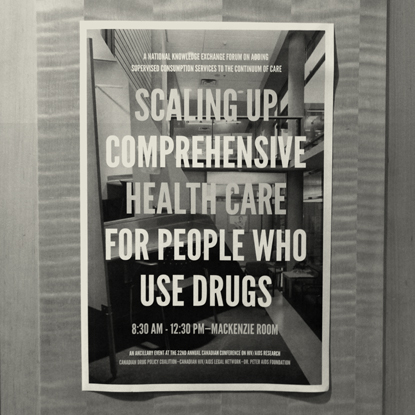
    Voilà la conclusion à laquelle sont venus plusieurs intervenants participant à un événement animé sur la faisabilité de la mise à l’échelle des services de consommation supervisée au Canada, dans le cadre de la récente conférence de l’Association canadienne des soins en sidologie (CAHR) tenue à Vancouver. Parrainé par le Dr Peter Centre, le Réseau juridique canadien VIH/sida et la Coalition canadienne des politiques sur les drogues, cet atelier d’une demi-journée a rassemblé des orateurs d’Ottawa, de Montréal, de Toronto et de Vancouver, en vue de discuter de leurs plans pour la mise à niveau de ces services à-travers le pays.

    Le plus célèbre de ces services est Insite, basé à Vancouver, en Colombie-Britannique. Un grand nombre de preuves provenant d’études effectuées sur Insite suggère que ce service unique comporte plusieurs résultats bénéfiques : il est utilisé par la population qu’il vise à servir, qui inclut plus de 10 000 clients. Et il est utilisé par des gens susceptibles de s’injecter des drogues en public de façon routinière. Ce service a également réduit les comportements à risque en réduisant le partage des aiguilles et en fournissant une éducation sur les pratiques d’injection plus sûres. Insite a favorisé l’inscription à des programmes de traitement pour la toxicomanie et a amélioré l’ordre public. On a également constaté une réduction marquée des décès par surdose, une sûreté accrue pour les femmes qui s’injectent des drogues, et que ce service ne mène pas à une utilisation accrue des drogues ou à une augmentation de la criminalité.[I]

    Mais l’opposition publique et les craintes politiques entravent toujours la mise à l’échelle de ces services. En dépit des avantages bien documentés, les opposants affirment toujours que ces services « favorisent » la consommation de drogues illicites. Ces déclarations s’appuient sur la prémisse erronée que la faute de fournir des services de santé aux gens qui consomment des drogues suffit à dissuader les gens de consommer des drogues. Tout ceci ne contribue qu’à éloigner les gens des soins de santé et à promouvoir des pratiques d’injection moins sûres pouvant mener à des blessures, à des infections et à la mort. Ces opposants ne comprennent pas que ces services favorisent l’engagement envers les soins de santé des populations difficiles à atteindre et protègent la dignité des personnes qui consomment des drogues en donnant priorité à leurs préoccupations de santé.

    L’opposition officielle du gouvernement fédéral a bloqué la mise en oeuvre de ces services salutaires, même en Colombie-Britannique. En 2007, le gouvernement fédéral a refusé de maintenir l’exonération légale accordée à Insite (Section 56 de la Loi réglementant certaines drogues et autres substances (CDSA)). Les partisans du site, y compris la PHS Community Services Society, VANDU, et la Vancouver Coastal Health, ont contesté ce refus jusqu’à la Cour suprême du Canada. En 2011, la Cour a statué en faveur de l’exonération, notant le droit des personnes à accéder à ce service de santé, et a ordonné au ministre fédéral de la santé d’accorder le maintien de l’exonération. Les sites futurs devront faire une demande d’exonération en vertu de la Section 56, afin d’éviter toute accusation criminelle pour violation de la CDSA.

    Il semble que le processus d’application pour demande de dérogation à la Section 56 sera onéreux. En raison de ces difficultés, certains intervenants à la Conférence de l’ACRV ont exhorté le public à envisager d’autres options, telles que des sites non autorisées moins dispendieux utilisant des modèles de soins administrés par des pairs.

    Le besoin est clair – la volonté existe – les résultats sont connus.  Exigeons du gouvernement fédéral qu’il facilite l’accès à ces services, afin que nous puissions sauver des vies, prévenir les maladies et protéger la dignité des personnes qui consomment des drogues.