Every person, regardless of their housing status or relationship to drugs, should be able to access safety. We expect our governments to uphold that, not put people at further risk. But that’s not always what happens.
Last week, the City of Barrie, Ontario discussed a controversial proposed public space bylaw that would introduce fines ranging from $500 to $100,000 for distributing food, water, clothing, shelter, or other essentials – like harm reduction supplies – to assist people without city authorization. This is not only unbelievably cruel, it’s bad policy: this bylaw punishes people harmed by systems, rather than addressing root causes. It doesn’t solve any problems, just introduces new ones.
As a national organization working with community groups across Canada, we know this proposed bylaw in Barrie is no anomaly – it’s just one particularly troubling example of law and policy that further endangers people at risk of dying from unregulated drugs, under the guise of public space legislation.
That’s why last week we filed a reportwith the United Nations Rapporteurs on Homelessness and Extreme Poverty outlining how laws like Barrie’s proposed bylaw violate human rights and put people at risk. Together with community partners, we’re calling attention to the need for a different path: one that upholds the human rights of all people and advances community health and wellness.
So, how do public space bylaws relate to drug policy? Let’s connect the dots. In Canada, most public space is regulated through municipal bylaws and other provincial, territorial, or federal land use legislation. These bylaws often criminalize activities related to drug use at the intersection of poverty and homelessness – like using drugs in public space. But the thing is, because our drug laws have made the unregulated market so dangerous, public space may actually be the safest place for people to use drugs, especially in communities that lack supervised consumption services. Being somewhere visible ensures proximity to others and access to emergency health care, outreach services, and harm reduction support. When we criminalize drug use in public space, we don’t solve the problem – we just push it out of sight, and in doing so, make it more dangerous.
There is a better path. This is a policy problem, and together we can change policy. To build communities where we can all access safety, we need to implement public health and human rights-based drug policy at every level of government. This includes full decriminalization of drug possession, equitable access to safe regulated supply programs, harm reduction equipment and services, and evidence-based, voluntary treatment that aligns with people’s needs and informed consent. It also means ensuring public space bylaws don’t target people who use drugs.
This UN submission is one step we can take to draw attention to this misguided approach, and support elected officials to enact good policy. As Barrie City Council and municipalities across this country navigate issues of public space, CDPC and our community partners are committed to advocating for the rights and well-being of people who use drugs, their loved ones and their communities – that’s all of us.
One day after Barrie City Council’s community safety committee heard presentations on a controversial proposed public space bylaw, local and national organizations have sent it to the United Nations Rapporteurs on Homelessness and Extreme Poverty for review.
The Canadian Drug Policy Coalition and Pivot Legal Society filed the report today, with endorsements from Barrie Housing and Homelessness Justice Network, Indigenous Harm Reduction Network and the Gilbert Centre, in response to a UN call for submissions on laws and policies that criminalize and punish people in poverty and homelessness. In the report, advocates and policy experts point to Barrie’s proposed bylaw as a particularly egregious example of public space legislation and policy in Canada endangering people living in homelessness and poverty, particularly those who are at risk of fatal drug poisoning.
“This bylaw targets unhoused people and their ability to survive,” said Sarah Tilley of the Gilbert Centre. “It effectively criminalizes being homeless — and interferes with the ability of us as outreach workers to carry out our potentially lifesaving work. Despite the public outcry and serious concerns from grassroots organizations and policy experts, the City of Barrie seems determined to move ahead with this harmful and ineffective approach.”
The proposed bylaw amendment would introduce fines ranging from $500 – $100,000 for distributing food, water, clothing, shelter, or other essentials to assist people with sleeping or protection from the elements without authorization from the city of Barrie. It came to Barrie City Council in May and June 2023. Met with significant public opposition, including a public statement from the Office of the Federal Housing Advocate, council referred the matter back to city staff for review and updates.
“This is not the kind of international attention we want Barrie to receive,” said Reverend Christine Nayler of Ryan’s Hope. “I am hoping to appeal to Council’s humanity and ask them to rethink these punitive bylaws that will harm our city’s most vulnerable residents, and to remind them that these proposed bylaws are a violation of the Charter of Rights and Freedoms. Passing bylaws that go against Charter Rights opens the city to legal challenges and will end up costing the city more than addressing the root cause of the issue: a lack of truly affordable and low-barrier housing. Investing dollars in prevention rather than punishment makes sense.”
In October 2021, the Canadian Drug Policy Coalition hosted health and social service workers, policy experts, people who use drugs, and other community members affected by the toxic drug crisis to discuss challenges and solutions. The resulting report identified six key recommendations for action, including:
increased access to deeply affordable housing;
funding for a lived experience advisory group to address the toxic drug crisis, and;
the creation of multi-sectoral decision-making tables to support municipal policy development for the City of Barrie.
“In the Barrie dialogues, we heard the need for community-driven solutions that lift people up, rather than cause harm,” said DJ Larkin, executive director of the Canadian Drug Policy Coalition. “Every person, regardless of their housing status or relationship to substances, should be able to access safety. The frontline services provided by Barrie’s community organizations are part of that. Our governments should be working to make people safer, not putting them at further risk.”
The UN submission comes as Barrie City Council considers next steps on the public space bylaw amendment. There is currently no public date for a council vote on the bylaw.
Founded in 2010, the Canadian Drug Policy Coalition works in partnership with more than 60 organizations and 7,000 individuals working to support the development of a drug policy for Canada that is based in science, guided by public health principles, respectful of the human rights of all, and seeks to include people who use drugs and those harmed by the war on drugs in moving towards a healthier society. Learn more at www.drugpolicy.ca
About Ryan’s Hope
Ryan’s Hope is a grassroots volunteer-based organization started in memory and honour of Ryan Nayler. Our mission is to advocate for and support people living with mental illness, substance use issues and experiencing homelessness. www.ryanshopebarrie.ca
About Barrie Housing and Homelessness Justice Network
The Barrie Homelessness & Housing Justice Network (BHHJN) is a multidisciplinary network of homelessness and housing advocates who have come together to advocate for the right to housing and the elimination of chronic homelessness in Barrie. www.bhhjn.ca
About The Gilbert Centre
The Gilbert Centre provides social and support services to empower, promote health, and celebrate the lives of people living with and affected by HIV and other sexually transmitted infections (STI) and the individuals and families from the lesbian, gay, bisexual, transgender, queer (LGBTQ) communities of Simcoe Muskoka. www.gilbertcentre.ca
Media contacts:
DJ Larkin
Executive Director, Canadian Drug Policy Coalition
Unceded territories of the xʷməθkʷəy̓əm (Musqueam), Sḵwx̱wú7mesh (Squamish) and səlilwətaɬ (Tsleil-Waututh) First Nations (Vancouver, B.C., Canada) – Today, the Canadian Drug Policy Coalition (CDPC) released the findings from its three-year Imagine Safe Supply study that examined ideas about safe supply participation with people who use drugs and frontline workers.
“The debate around a safer supply of drugs is making headlines across Canada, for all the wrong reasons,” said DJ Larkin, Executive Director of the CDPC. “Misinformation and stigma are turning attention away from evidence, data and meaningful engagement with people most affected by our current toxic drug crisis. These misinformed narratives have the potential to do very real harm, and worsen an already unbearable situation that is causing the deaths of thousands of people every year. This research refocuses on what’s possible when we work toward solutions that are effective and meaningful for people who use drugs.”
“In our research, we looked into the gaps between current access to regulated supply of drugs and ‘desired’ safe supply,” said Erin Howley, Senior Research Associate with the CDPC, and the Imagine Safe Supply project lead. “This data offers deep insight into what effective safe supply based on the leadership of people who use drugs could look like.”
The three-year, community-based qualitative research project involved in-depth interviews with 33 people from across British Columbia, Alberta, Ontario, and Quebec about what they need for safe supply. Key findings from Imagine Safe Supply include:
The values of community-building, autonomy and self-determination, mutual care, trusted relationships, and cultural inclusion are central to the design of any effective safe supply program or service.
Effective safe supply includes a range of choices around drug options and dosages that reflect people’s unique reasons, needs and desires for using drugs.
Holistic safe supply would offer a spectrum of models and supports to address the diverse needs and person-centered goals of PWUD;there is no one-size fits all approach.Effective safe supply supports a full range of choices including consensual and equitable detox and treatment options, and holistic social and economic supports, including housing.
All levels of government and decision-makers need to prioritize approaches to safe supply that centre the knowledge, leadership, and relationships between people who use drugs.
The Imagine Safe Supply research team includes people who use drugs and frontline workers, as well as graduate students and staff of the Canadian Drug Policy Coalition at Simon Fraser University. The research team co-created and led every stage of the project, including research design, interviews, data analysis, and knowledge sharing. This research was undertaken through a partnership with Thunderbird Partnership Foundation, which stewards all data related to First Nations research participation in accordance with OCAP® Principles; First Nations findings have not yet been published.
“Our project has the word ‘imagine’ in its title for a reason,” said Phoenix Beck McGreevy, Community Research Associate. “We asked people to envision their ideal safe supply program, from the available substances to the staff and the setting. When people ventured outside the realm of what’s currently possible, that was where the really beautiful data lived.”
“This research changes the channel on the safe supply debate, by placing people who use drugs and frontline workers front and centre,” said Howley. “These findings offer resources that bring real-world experience to the drug policy debate, and provide knowledge and guidance to service providers, clinicians and decision-makers developing effective responses to the drug poisoning crisis in Canada.”
The CDPC is calling on decision-makers in Canada to increase the scale and scope of safe supply access across Canada, including rural and remote areas and to underserved populations. This includes ensuring access to regulated drugs of known contents and potency to act as an alternative to the toxic unregulated drug supply, and ensuring people using drugs – with an emphasis on racialized and Indigenous people who are disproportionately affected by this crisis – are fully involved in safe supply design and delivery.
Photographs of the Imagine Safe Supply research team
Illustrated headshots of the Imagine Safe Supply research team
Illustrations from the Imagine Safe Supply Zine, a forthcoming knowledge translation document created to share findings from the research
Background:
The Canadian Association of People Who Use Drugs (CAPUD) defines safe supply as “a legal and regulated supply of drugs with mind/body altering properties that traditionally have been accessible only through the illicit drug market”. Safe supply means drugs that are legally regulated with a known potency and composition. More information on Imagine Safe Supply and its findings can be found at https://drugpolicy.ca/imagine-safe-supply/
About the Canadian Drug Policy Coalition
Founded in 2010, the Canadian Drug Policy Coalition works in partnership with more than 60 organizations and 7,000 individuals working to support the development of a drug policy for Canada that is based in science, guided by public health principles, respectful of the human rights of all, and seeks to include people who use drugs and those harmed by the war on drugs in moving towards a healthier society. Learn more at www.drugpolicy.ca
CDPC’s Executive Director, Donald MacPherson, is retiring. On behalf of the CDPC Steering Committee, I want to recognize his incredible contributions to drug policy and the CDPC, and thank him for his unwavering mission to make drug policy humane, equitable, realistic and just.
Before bringing his passion and insight to the creation of CDPC, Donald worked with the City of Vancouver as the Director of the Carnegie Centre, and then as the city’s Drug Policy Coordinator. In that latter role, he published Vancouver’s ground-breaking Four Pillars Drug Strategy in 2000. This framework reflected the then-still-controversial notion that health care for people who use drugs must be understood broadly, beyond just abstinence from drug use, positioning harm reduction as a necessary element of any sensible, effective strategy.
Donald co-founded the Canadian Drug Policy Coalition in 2011 to bring people together from across the country in a coordinated, ongoing effort to challenge and reform drug policy as a matter of not only local but national concern. As the drug poisoning crisis exploded, Donald positioned CDPC as a leader in advocacy. For years, he has convened people who use substances, politicians, health and legal experts, and other stakeholders to focus upon specific issues such as supervised consumption spaces and safe supply, decriminalization/legalization/regulation and many other critical interventions. Through changing governments at municipal, provincial and national levels, Donald has created strategies to work well with those who consider drug policy reform a valid pursuit, as well as those who are opposed because of fear, misunderstanding or ideology.
Donald has been deeply committed to the meaningful and active involvement of people who use substances and has heightened the voices of people affected the most by unjust drug policies. Similarly, he has sought to ensure that CDPC’s work confronts the truths of the racism embedded in punitive drug policies and contributes to ongoing efforts at reconciliation with the First Peoples of Canada.
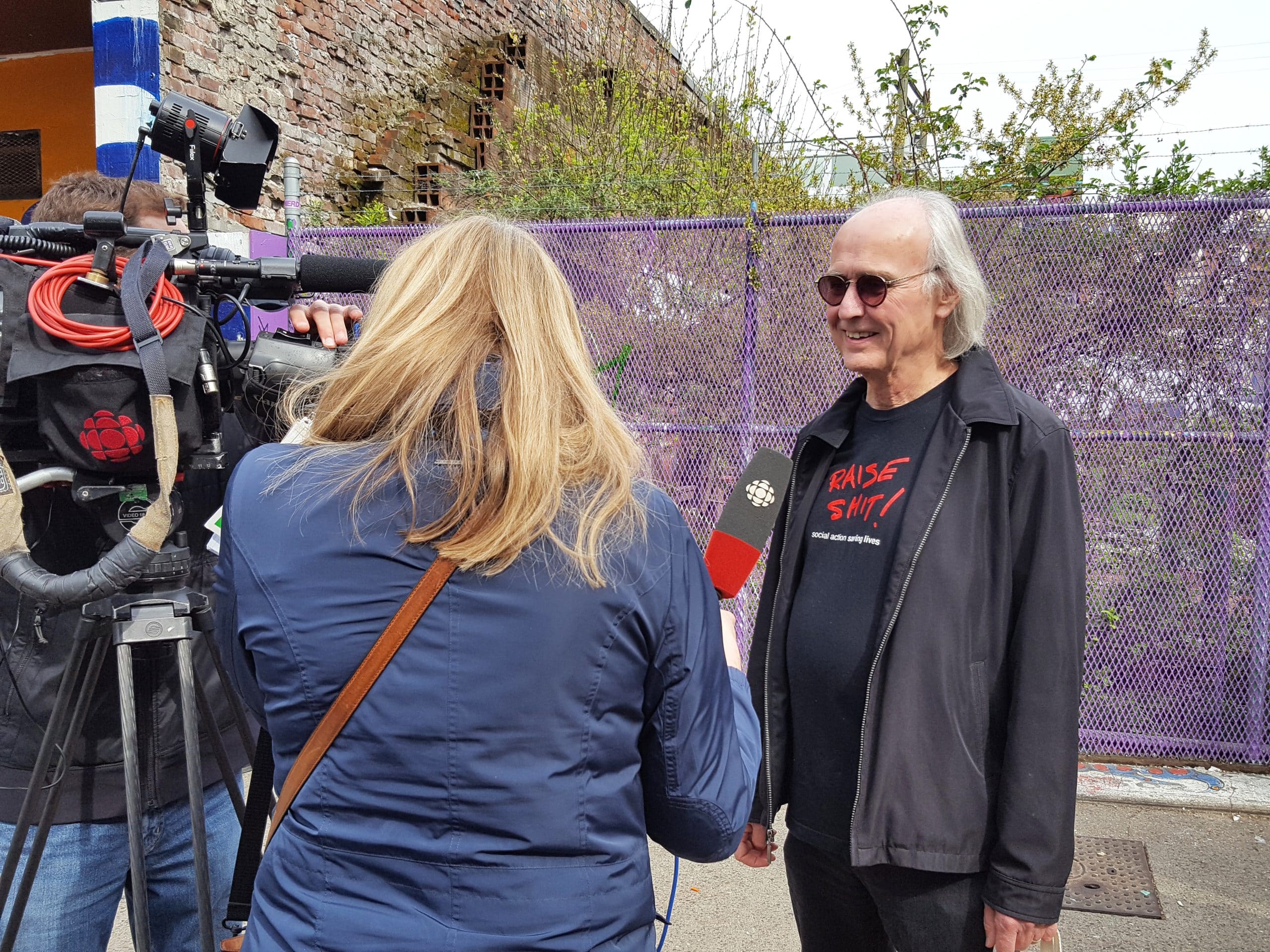
In addition to his many accomplishments in community, Donald is also co-author of Raise Shit! Social action saving lives (2009) and More Harm than Good: Drug policy in Canada (2016), regularly contributes to various reports and scholarly papers, and has shared his knowledge and experience around the world, including as vice-chair of the Board of the International Drug Policy Consortium, a civil society organization working to improve policy responses to drugs globally.
Donald served on Health Canada’s Expert Task Force on Substance Use, which issued unambiguous recommendations to end criminalization of simple possession and other measures to support and protect people who use drugs and communities – measures we’re finally seeing some progress on. He is an adjunct professor at Simon Fraser University, and has also been awarded an Honorary Doctorate from Adler University in Chicago/Vancouver, the Queen Elizabeth II Diamond Jubilee Medal, and Nora and Ted Sterling Prize in Support of Controversy at Simon Fraser University for his contribution to social justice in the field of drug policy.
Donald has been a mentor, teacher and example of commitment to many people from all walks of life. He has affected people’s views and persuaded the unpersuadable. He has been a giant on the national and international stage. But he has also been humble, kind, quiet, patient, respectful, approachable, and creative. He will speak of drug policy as effectively in a city of several million as in a small remote community. He is diplomatic when needed and forthright when necessary.
Donald has been a force for change in this country, advancing equity, justice and human rights. In recent months, as word that Donald would transition into a well-deserved retirement, one of the phrases I have heard most often is “How can we fill Donald’s shoes?”. It will be difficult. But Donald will leave us with an army of informed, committed, energetic people who understand the issues of drugs and drug policy, and who are enthusiastic to push forward with advocacy to make the world better.
Thank you, Donald! You will be missed greatly! Have a very happy retirement!
Après avoir cherché à travers tout le pays, la Coalition canadienne des politiques sur les drogues (CCPD) a le plaisir d’annoncer que DJ Larkin a été nommé directeur général de l’organisation. DJ succédera à Donald MacPherson, le directeur général et fondateur de la CCPD, qui prendra sa retraite plus tard cette année après avoir travaillé plus de dix ans au sein de la Coalition.
DJ réside actuellement sur les terres indigènes non cédées des peuples xʷməθkʷəy̓əm (Musqueam), Skwxwú7mesh (Squamish) et səlil̓wətaʔɬ (Tsleil-Waututh), et se consacre à l’apprentissage continu, à l’amélioration de soi et à la prise de mesures pour éliminer le colonialisme.
DJ Larkin est un avocat et un défenseur juridique estimé qui travaille depuis plus de dix ans sur des questions touchant les personnes victimes de criminalisation et de la marginalisation systémique. DJ a joué un rôle central dans la représentation des personnes qui consomment de la drogue en soutenant des groupes gérés par des pairs dans le quartier Downtown Eastside de Vancouver et en travaillant avec des personnes et des organisations de nombreuses autres régions et communautés. DJ a également représenté des gouvernements indigènes, élus et héréditaires, dans le cadre de litiges concernant les droits, les terres et la gestion des ressources. En 2017-2018, DJ a aussi collaboré à l’enquête et à la rédaction d’un rapport détaillé(en anglais) sur l’exclusion et la marginalisation systémiques des personnes vivant à l’intersection des problèmes de pauvreté, de précarité du logement et de consommation de substances criminalisées, et ce, dans le but de provoquer une réforme systémique des lois et des politiques.
« La vision de la CCPD est évidente et sa mission est inébranlable », a déclaré DJ à propos de la Coalition. « C’est le fruit du travail de générations de gens brillants et dévoués qui consomment de la drogue, de militants, d’universitaires, d’alliés, de défenseurs et de responsables politiques comme Donald MacPherson. Je suis conscient qu’il y a encore beaucoup de travail à faire et que la barre est haute. Je me sens honoré d’avoir cette chance, et j’ai hâte de me lancer dans le travail plus tard ce printemps. »
DJ Larkin se joindra à la CCPD en tant que directeur général en avril 2023.
Contactez nous:
Alessia Matsos
Coordonnatrice des communicationsLa Coalition canadienne des politiques sur les drogues[email protected]
(905)-869-7451
In our drug policy work, the Canadian Drug Policy Coalition (CDPC) acknowledges the colonial ideologies, systems, and processes in which we operate within.
We strongly feel that we must emphasize that colonial systems continue to cause harm and that our work is embedded within these systems. CDPC is a part of Simon Fraser University—and large institutions such as these move in ways that are often rigid, culturally insensitive, and uncreative when it comes to working with Indigenous peoples. This is evident when it comes to paying Indigenous people in ways that are culturally respectful. The protocol of requesting receipts and invoices, and sometimes waiting for weeks to get paid, is a huge barrier to many—and a disincentive to collaboration processes that must be meaningfully addressed.
We feel it is important to acknowledge that there have been times when we acted insensitively and are grateful to those who have taken the time to educate us on how these processes may not best serve key groups that we truly wish to serve efficiently and compassionately. We are moved by these relationships and would like to honour them by striving to improve how we ensure our Indigenous allies are paid in a way that works best for them.
Municipal governments, along with federal and provincial governments, have an important role to play in reforming harmful drug policies. To support public health and human rights, the Canadian Drug Policy Coalition (CDPC) advocates for full decriminalization of simple drug possession and necessity trafficking*, investment into social supports such as housing, expansion of safe supply and harm reduction measures, and legal regulation of all drugs under a single regulatory framework.
To forward key policy changes such as decriminalization, and to support harm reduction measures such as supervised consumption sites, having support from city council can make all the difference in implementing the changes that are needed to address the drug toxicity crisis.
*Necessity trafficking is sharing or selling drugs for subsistence, to support personal use, or to provide a safe supply.
AVERTISSEMENT : Ce message contient des références à des abus sexuels.
Le 12 mai 2022, la Coalition canadienne des politiques sur les drogues (CCPD) a publié une déclaration. Cette déclaration, qui a été supprimée du site Web drugpolicy.ca/fr le 20 mai, abordait la question d’un incident d’abus sexuel qui a été signalé en 2018 lors d’un essai clinique mené par la « Multidisciplinary Association for Psychedelic Studies » aux États-Unis (MAPS) et qui impliquait également MAPS Canada. La déclaration de la CCPD a indiqué qu’il y avait des indications que la participante a « a été ignorée, minimisée, supprimée et utilisée pour la forcer à rester dans une position d’extrême précarité sociale et économique » par MAPS. La CCPD n’a pas effectué de vérification indépendante de ces allégations. La CCPD a retiré sa déclaration. Nous regrettons toute erreur dans la déclaration originale. La CCPD soutient toujours fermement les victimes de négligences cliniques impliquées dans des essais de thérapie psychédéliques.
Nous voulons préciser que la déclaration de la CCPD du 12 mai et cette déclaration ne représentent pas forcément les opinions de plus de 50 organisations qui font partie de la Coalition canadienne des politiques sur les drogues.
Throughout the country, dozens of events are being held on August 31 to honour those who have been lost to drug overdose and to raise awareness of the toxic drug poisoning crisis. The following list of events are just some of the initiatives our friends and partners are holding to acknowledge this day:
ENSEMBLE:
In collaboration with John Howard Society, ENSEMBLE is having a free community BBQ on August 31st from 11am-3pm for International Overdose Awareness Day (80 Weldon St, Moncton). We will also be doing free Naloxone training! Individuals can submit names of loved ones lost to the toxic drug supply to [email protected] and we will display them on hearts to commemorate them.
ENSEMBLE is also hosting a candlelight vigil at city hall on August 31st at 8pm. They will read out names, light candles and take a moment to collectively grieve.
Sagkeeng Arena Complex and Sagkeeng Arbor Aug 23 – 26, daily from 10 a.m. – 3 p.m. (see poster for details)
Moms Stop The Harm:
Moms Stop the Harm encourages members to consider a variety of actions in your community on August 31 to mark IOAD 2022. These include:
Make, wear and distribute purple ribbons.
Organize or participate in an IOAD event.
Leave an empty purple chair for your loved one. Take photos and share on social media.
Demonstrate what a regulated, safe supply could look like. You can do so by ordering a demonstrator box to display at your event. Order by Aug 10, 2022 by sending your name, address and event to [email protected].
Check out the different communities they’ll be in on August 31 here!
Ryan’s Hope and Moms Stop The Harm
Ryan’s Hope and Moms Stop The Harm will be meeting at City Hall for a flag raising, proclamation from the Mayor, and a short ceremony of remembrance. Organizations will be on hand to hand out harm reduction kits, and naloxone. 9:30 a.m. at Barrie City Hall, 70 Collier St.
Ryan’s Hope and Moms Stop The Harm will meet in honour of those we have lost for a time of remembrance, celebration, and mourning. Speeches, a moment of silence, and a candlelight vigil will be held. If you would like your loved one honoured, email your photo and memory to [email protected]. 8 p.m. at Barrie City Hall, 70 Collier St.
United Way Simcoe Muskoka
To align with Overdose Awareness Day, United Way Simcoe Muskoka is hosting a documentary screening of Flood: The Overdose Epidemic in Canada, which tells the human story behind the overdose epidemic. Following the screening will be a panel discussion with local experts and people with lived experience to shine a light further on this local crisis. It is a free event, tickets here: https://tickets.algonquintheatre.ca/TheatreManager/1/online?performance=2226
Doors open at 6:30 p.m. show starts at 7 p.m. at Algonquin Theatre in Huntsville, 37 Main Street East.
Sandy Hill Community Health Centre
Please join us for guest speakers, narcan training and tabling by related organization! 11:30 am at 120 Lisgar st – Human Rights Monument.
Chilliwack Community Action Team and Shxwha:y Village
Mountainside Harm Reduction Society is partnered with the Chilliwack Community Action Team and Shxwha:y Village to host an event on Wednesday August 31st from 12pm – 4pm. Resources, memorial activities, drug checking and consumption services, support groups, free food trucks & a live butterfly release will be happening at 44680 Schweyey Road.
Blood Ties Four Directions – Yukon
Blood Ties Four Directions will be holding a space where the community can share memories and hopes for change in a supportive sharing circle. We will be providing a memorial tree for those who have passed and candles. We will also be having a few speeches and introducing the “Getting to Tomorrow dialogue”. We will be providing some stew and bannock for refreshments. Our event will take place on the 31st from 11am-2pm (6189 6th Avenue Whitehorse, Yukon).
The East Kootenay Network of People who Use Drugs will be hosting our 3rd annual protest 🪧 in Cranbrook. We will meet at ANKORS at 12:00pm 🕛. From there we will march through down town Cranbrook, to City Hall.
Black-CAP
Join us on 31 August 2022 as we raise awareness of overdose and reduce the stigma of drug related deaths. It’s a time to remember our loved ones and a time to act! Learn how to recognize and respond to an Overdose. Naloxone training and kits are available. 12 pm – 4 pm at Christie Ossington Neighbourhood Center (854 Bloor Street, West).
Avenue B
Avenue B will be hosting a Harm Reduction Fair at Kings Square from 10 am – 2 pm with tables from Moms Stop the Harm, SUNAR, Avenue B (including Naloxone training), Ridgewood, Riverstone Recovery, and more. 100 King St, Saint John.
ANKORS:
ANKORS, the Rural Empowered Drug Users Network, Mental Health and Substance Use, Circle of Indigenous Nations Society, Nelson Fentanyl Task Force, Freedom Quest, The HUB, Kootenay Boundary Supported Recovery, and other local resource providers and groups will be hosting a Vigil from 1 pm – 2 pm, and a Knowledge Walk from 2 pm – 3 pm in Cottonwood Falls Park, Nelson.
Coalition of Substance Users of the North (CSUN)and Community Partners
CSUN and community partners are inviting the community to attend their event on August 31st from 12 pm – 3 pm. The event will take place at the front entrance of the walking bridge on Front Street. They will be hosting an opening ceremony, open mic, memorial flower drop, Elder/partner/honourary guest acknowledgement, and closing ceremony. Learn more about the event here.
Maple Ridge Street Outreach Society
Join the Maple Ridge Street Outreach Society for a Pancake brunch to honour and remember loved ones lost to the Fentanyl poisoning epidemic. The event will be a space to share food and stories to remember our loved ones and call for actions. The brunch is from 10 am – 12 pm at Neighbourhood House, 11739-223 Ave in Maple Ridge. Learn more about this event here.
Mission Overdose Community Action Team
Mission Overdose Community Action Team will be hosting a memorial art walk from 4 pm – 7 pm. Please meet at 1st Ave in Mission. Art will be displayed on First Ave. with support of the Mission Downtown Business Association. Live Music, Resources, Refreshments, Empty Chair Campaign, Naloxone training, conversation. Memorial open mic & guest speakers 5:30pm. Learn more about this event here.
ROAR – Reducing Overdose: Abbotsford Response
ROAR will be hosting an event from 11 am – 2 pm at Jubilee Park. There will be Keynote speakers, Naloxone training, information booths, interactive art activities, and food trucks. Learn more about the event here.
Sunshine Coast Community Action Initiative
The Sunshine Coast Community Action Initiative is hosting an event from 3-6 PM at Hackett Park in Sechelt, BC. Enter the park at the corner of Ocean Avenue and Dolphin Street. The event will bring recognition to the lives lost to overdose and call for action from government to work harder to decrease the fatalities from this crisis. The event will include speakers, music, local resources, and an intentional space to memorialize those who have been lost.
Memorial for Overdose Outrage
The Memorial will start between 1:30pm until about 3 pm. Please meet in the courtyard (churchayard next to 955 Queen St E).
CN Tower Illumination
In honour of IOAD, the CN Tower will be illuminated in purple for all to see.
Parkdale Queen West Community Health Centre
Join the Parkdale Queen West Community Health Centre from 11 am – 3 pm for their event.